Where Do Good Startup Ideas Actually Come From?
And how do you know if one is actually worth building? Most people think startup ideas come from a sudden moment of inspiration. You see a problem. You get excited. You think: "Someone should build an app for this."
And suddenly, you have a startup idea. But there is a problem. Having an idea is easy. Finding a good idea is much harder.
At RSM, we believe startup ideas can be discovered, not just imagined. So where can you actually find them?
1. Look at Problems You See Every Day
One of the easiest places to find ideas is your own environment. Look at what people complain about. What takes too much time? What is still being done manually? What requires too many phone calls? Where are people using Excel, WhatsApp or paper because there is no better system?
These everyday frustrations can reveal interesting opportunities.
Don't immediately ask: "Can I build an app for this?"
First ask: "Why does this problem exist?"
2. Look at Businesses, Not Just Technology
A common mistake is searching for the next big technology and then trying to find a use for it. Instead, look at industries. Real estate. Healthcare. Education. Construction. Logistics. Agriculture. Finance. Retail.
Every industry has inefficiencies. Every industry has people doing repetitive work. Every industry has customers who are not completely satisfied. That's where opportunities hide.
3. Listen to Complaints
Complaints are underrated sources of business ideas. When someone repeatedly says:
- "This takes forever."
- "Why is this so complicated?"
- "There should be an easier way."
- "I hate doing this every month."
Don't just hear the complaint. Investigate it. A complaint doesn't automatically mean there is a business opportunity. But it can be the beginning of a very good research question.
4. Look at Existing Solutions
Sometimes the best startup opportunity isn't creating something completely new. It's improving something that already exists. Ask:
- What are people using today?
- What do they dislike about it?
- What is too expensive?
- What is too complicated?
- What is missing?
- Who is being ignored?
A market with existing competitors isn't necessarily a bad sign. It can actually prove that people already spend money solving the problem. Your challenge is to discover what can be done better.
5. Look for Behaviour Changes
New businesses often appear when people's behaviour changes. People started working remotely. People started consuming short-form video. Businesses started adopting AI. Digital payments changed how people transact.
When behaviour changes, new problems appear. And new problems create new opportunities.
So don't just watch technology. Watch people.
6. Now Comes the Important Part: Validation
Finding an idea doesn't mean you should build it. Before spending months developing a product, test the idea. Start with five simple questions:
- Problem: Does this problem actually exist?
- Customer: Who experiences it most?
- Frequency: How often does it happen?
- Existing Solution: How do people solve it today?
- Willingness to Pay: Would someone actually pay for a better solution?
If you cannot answer these questions, you probably don't know enough about the idea yet.
Don't Ask: "Do You Like My Idea?"
This is one of the biggest mistakes founders make. You tell someone: "I'm building an app that does X. Would you use it?" They might say: "Yeah, sounds great!"
That's not validation. Instead, ask about their current behaviour.
- "How do you currently solve this?"
- "When did you last face this problem?"
- "How much time does it take?"
- "What does it cost you?"
- "What have you already tried?"
Real behaviour is usually more valuable than hypothetical opinions.
Build Less. Learn More.
You don't always need a complete product to validate an idea. You can start with:
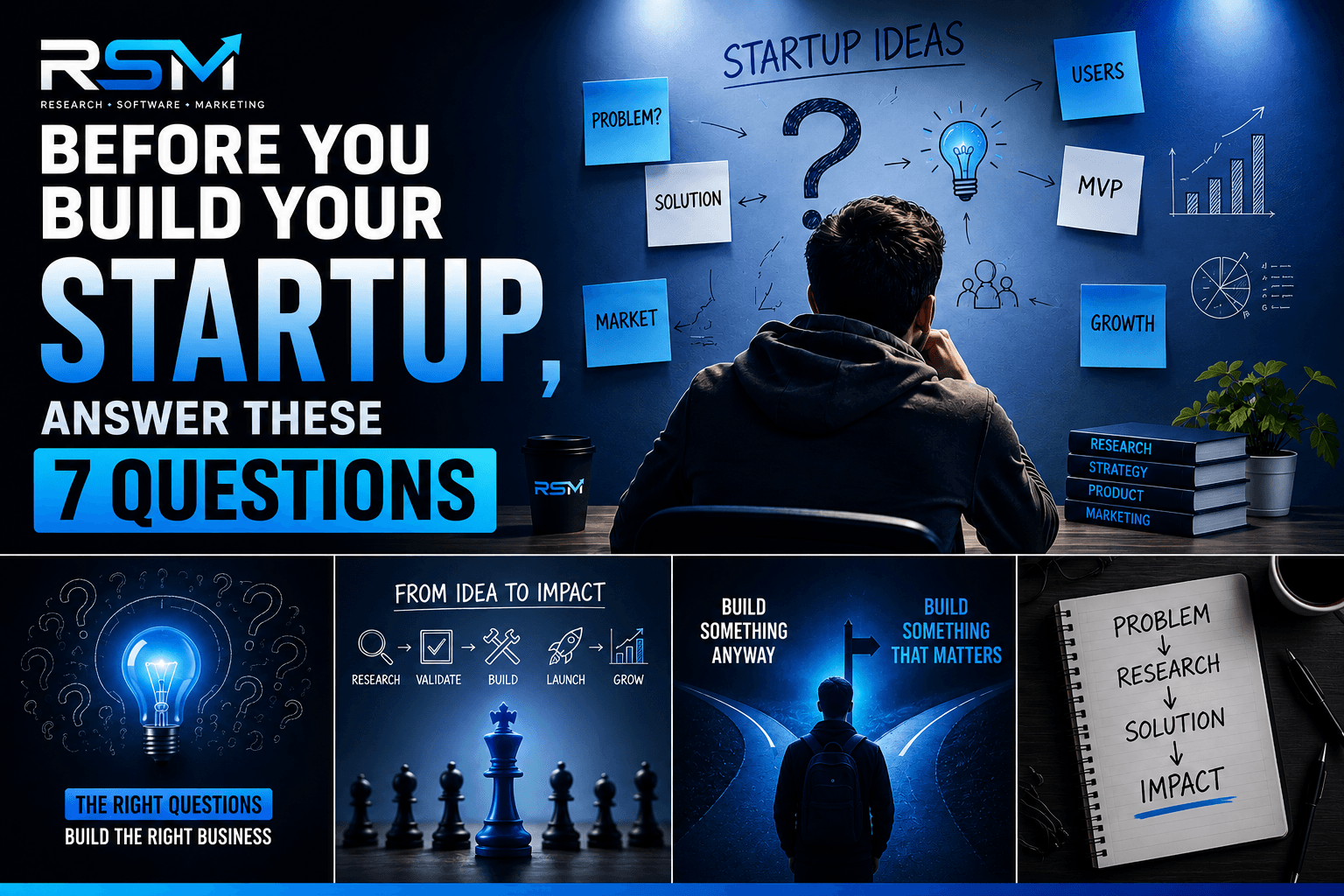
Conversation → Research → Prototype → Experiment → First Customer
Only then should you invest heavily in building the product. This can save founders months of development and potentially thousands of rupees.
The RSM Way
This is one of the ideas behind RSM. We don't want to start with: "What software should we build?" We want to start with: "What problem is worth solving?"
Then:
Research → Validate → Build → Market → Learn
Because a startup isn't successful simply because its product works. The product needs to solve a problem that people actually care about.
Your Next Startup Idea Might Already Be Around You
You don't necessarily need to invent something nobody has ever seen before. Look around. Watch how people work. Talk to customers. Study industries. Listen to complaints. Observe changing behaviour. Look at existing businesses.
And most importantly: Ask better questions.
Your next startup idea might not come from a brainstorming session. It might come from something you've been ignoring every day. The opportunity is often hidden inside the problem.